The Physics of Refractive Caustics
A caustic is the envelope of light rays reflected or refracted by a curved surface, concentrating light into bright filaments and cusps. While most computer graphics software treats caustics as an expensive rendering artifact, Photophane solves the inverse problem:
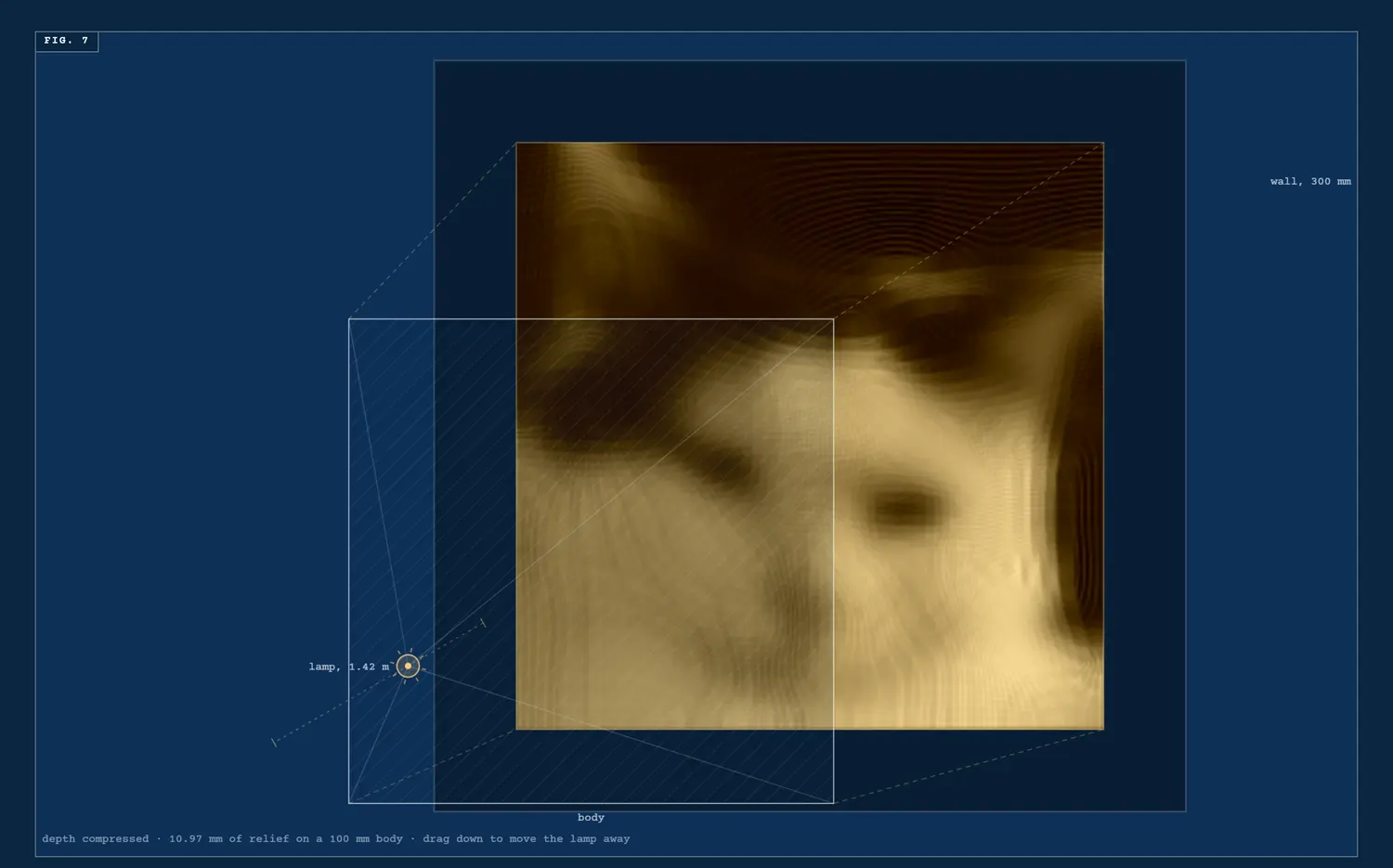
Given a target grayscale photograph, what 3D surface topography must be machined into a clear acrylic plate such that parallel rays passing through it bend and accumulate on a distant wall to form the exact photograph?
Inverse Optimal Transport & Surface Integration
Photophane solves an inverse optimal transport problem by formulating a mapping from a uniform light distribution to target image intensity. It derives the required normal vector field via Snell's law of refraction and integrates the gradient field into a continuous, height-bounded 3D surface mesh.
The system exports watertight STL geometry suitable for stereolithography (SLA) resin 3D printing or high-precision 5-axis CNC acrylic milling.
The Core Theme Behind this Portfolio
The animated light simulation running on the homepage hero of this portfolio is the forward physics engine of Photophane: 82,000 rays refracting across a simulated dynamic fluid surface and accumulating on a 2D density grid with chromatic dispersion.